
WELCOME BONUS 200%
UP TO €1500 + 200
FREE SPINS
UP TO €1500 + 200
FREE SPINS
Home → Blackjack
Blackjack at Ggbet: Variants, Rules and Payouts
What Hole Card Means at a Live Table
The dealer in Evolution's Infinite Blackjack holds one face-down hole card to complete the hand, which is revealed only after all players act. This structural rule prevents immediate bust calculations for the player and forces adherence to strict basic strategy charts rather than intuitive guesses. The delay in revelation adds a layer of analytical complexity to every decision made during the betting phase.
Infinite Blackjack features an RTP of 99.47% with bets ranging from 1 to 5,000 EUR, offering unlimited seats at the virtual table. The presence of the hole card means players cannot see the dealer's potential blackjack until the resolution phase concludes. This mechanic ensures that side bets like Any Pair or Hot 3 resolve independently of the main game outcome timing.
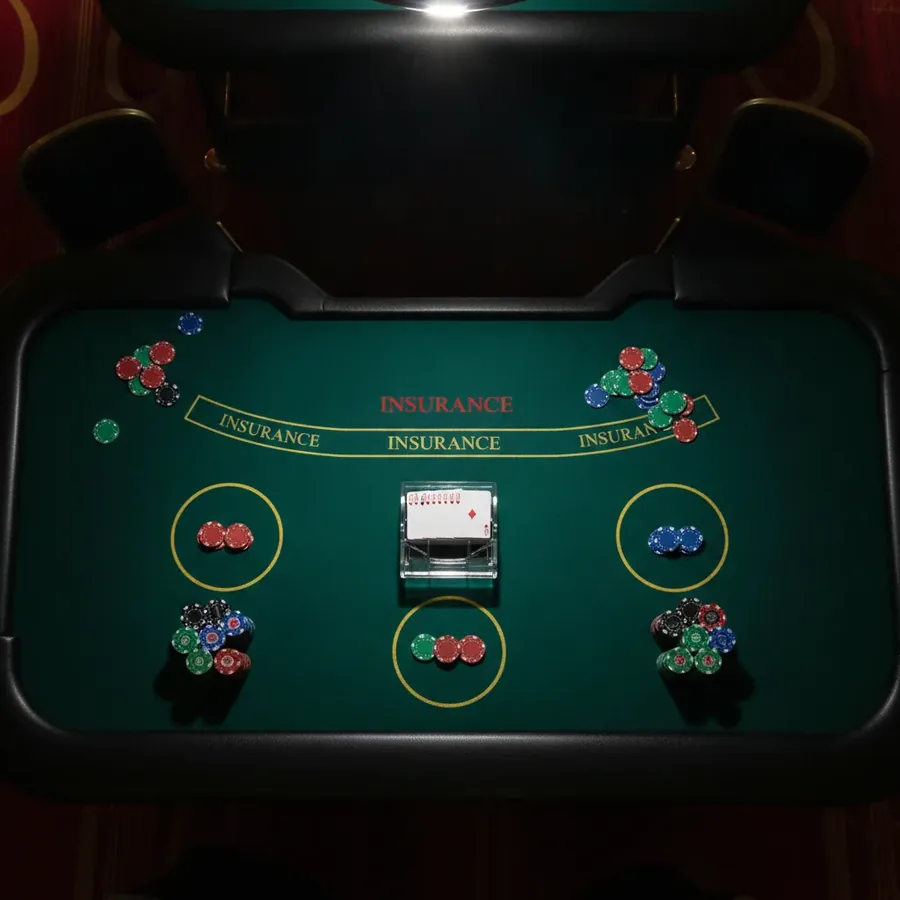
Live Table vs RNG Table: Speed and Limits
Evolution's Lightning Blackjack operates between 1 and 2,500 EUR with an RTP of 99.56%, delivering multipliers up to 25x on winning hands. Unlike RNG tables, this live variant processes fewer hands per hour due to real-time dealing and multiplier animations. Players must adjust their bankroll management strategies to account for the slower velocity of gameplay compared to digital equivalents.
Why Loss Progression Quickly Reaches Table Limit
Blackjack Party at Evolution imposes a maximum bet of 1,000 EUR per hand, which constrains aggressive progression strategies during losing streaks. When a player doubles their stake after every loss, the required bankroll grows exponentially and hits this ceiling within four or five consecutive defeats. This hard cap prevents the recovery of previous losses through standard martingale systems on high-limit tables. The restriction ensures that variance remains manageable for both the operator and the participant.
Infinite Blackjack allows wagers up to 5,000 EUR, offering significantly more room for progressive betting schemes compared to standard tables. A player starting with a 10 EUR base bet can escalate their exposure much further before encountering the table maximum limit. This higher threshold accommodates serious players who utilize complex staking plans without immediate interruption from casino restrictions. The expanded limit supports longer sessions of mathematical experimentation within the game framework.
Lightning Blackjack caps bets at 2,500 EUR, sitting between the party atmosphere and the infinite model in terms of financial flexibility. Progressive systems must account for this mid-range limit when calculating the probability of hitting the ceiling during extended downswings. The lightning multipliers do not alter the fundamental constraint of the maximum wager size itself. Players must adjust their unit sizing to ensure their progression strategy remains viable within these specific bounds.
Which hands are excluded from Surrender?
Late Surrender is only permitted after the dealer checks for blackjack, meaning players cannot surrender if the dealer holds an ace or ten-value card initially. If the dealer reveals a natural twenty-one, the hand ends immediately and the surrender option becomes completely unavailable to the participant. This rule protects the house edge by removing the ability to cut losses against a potential dealer win. The exclusion applies universally across all standard late surrender variants offered at the venue.
The surrender mechanic returns fifty percent of the original stake when exercised correctly, providing a statistical advantage of approximately 0.08 percentage points against the house. This benefit improves the overall return to player rate but is strictly conditional on the timing of the decision relative to the dealer's hole card. Early surrender, which offers greater value, is extremely rare and generally not found in modern online implementations. Players must rely on the late version for any loss mitigation strategy.
Hands totaling sixteen or seventeen are the primary candidates for surrender due to their poor mathematical expectation against a dealer showing a ten or ace. However, a hand containing a pair or suited cards may have different strategic values that make surrender less optimal than splitting or standing. The decision depends heavily on the specific composition of the cards rather than just the total sum. Correct application requires strict adherence to basic strategy charts provided by the software provider.
Ace Split: only one card per hand
When a player splits a pair of aces, each new hand receives exactly one additional card, preventing further doubling or splitting actions on those specific hands. This restriction limits the potential upside of the split but maintains the structural integrity of the game rules defined by the developer. Resplitting aces is sometimes allowed but typically still restricts subsequent actions to single-card draws only. This rule variation significantly impacts the expected value of the split maneuver.
Resplitting aces improves the return to player by approximately 0.08 percentage points compared to games that forbid this action entirely. Allowing the creation of multiple hands from a single pair increases the opportunities for favorable outcomes despite the one-card limitation. The mathematical benefit is modest but relevant for precision players tracking long-term house edges. This rule modification is often paired with other liberal conditions to enhance overall fairness.
Double After Split (DAS) is generally prohibited on split aces, forcing players to stand or hit with whatever two-card total they receive. This prohibition reduces the flexibility of the split strategy and lowers the overall profitability of the maneuver compared to non-ace pairs. Players must accept the resulting hand value without the option to increase their wager further. The combination of one-card limits and no doubling creates a distinct risk profile for this specific play.
Blackjack variants at a glance
| Variant | Payout | House edge | Rule | Bet range |
|---|---|---|---|---|
| Blackjack Ein Deck, klassische Regeln, 3:2 | 99.85% | 0.15% | Weniger Decks = niedrigerer Vorteil; ein Deck gibt ca. −0.48 Prozentpunkte gegenüber 8 Decks. Oft durch 6:5 Auszahlung kompensiert. | Blackjack 3:2, Gewinn 1:1 |
| Blackjack Auszahlung 6:5 statt 3:2 (6 Decks) | 98.15% | 1.85% | Ersatz von 3:2 durch 6:5 fügt exakt +1.39 Prozentpunkte zum Vorteil des Casinos hinzu – stärker als jede andere Regeländerung. Bei $10 Einsatz zahlt Blackjack $12 statt $15. | Blackjack 6:5, Gewinn 1:1 |
| Blackjack Surrender (Late Surrender) – Regel-Effekt | n.a. (Regel-Modifikator) | −0.08 Prozentpunkte | Spieler gibt Hand nach Dealer-Blackjack-Prüfung auf, verliert die Hälfte des Einsatzes. Verbessert RTP um ca. 0.08 Prozentpunkte. Early Surrender ist wesentlich wertvoller (bis −0.6 Prozentpunkte), aber extrem selten. | Rückzahlung 50% des Einsatzes |
| Blackjack Insurance / Versicherung (6–8 Decks) | 92.53% | 7.47% | Separate Nebenwette bis 50% der Hauptwette, wenn der Dealer ein Ass hat. Basisstrategie schreibt IMMER Ablehnung vor (außer Karten zählen bei True Count ≥ +3). Bei einem Deck Vorteil ≈ 5.88% | Insurance 2:1 |
| Blackjack Liberal Vegas Strip (liberale Regeln, 3:2) | 99.72% | 0.28% | Günstigste Regelkombination: S17 + DAS + Resplit + Late Surrender. Standardabweichung 1,15 | Blackjack 3:2, Gewinn 1:1 |
| Blackjack Split / Double / H17 – Regel-Effekte | n.a. (Regel-Modifikatoren) | H17 +0.22 Prozentpunkte; RSA −0.08 Prozentpunkte; DAS −0.14 Prozentpunkte | Dealer Hits Soft 17 verschlechtert RTP um 0.22 Prozentpunkte; Resplit Aces verbessert um 0.08 Prozentpunkte; Double After Split verbessert um ca. 0.14 Prozentpunkte; 6 Decks statt 8 – ca. 0.02 Prozentpunkte. | Double – Einsatz ×2 mit einer Karte; Split – bis 4 Hände; Ass-Split meist mit einer Karte. |
Side Bets Increase House Edge to 5 Percent
Infinite Blackjack offers four side bets including Any Pair, 21+3, Hot 3, and Bust It, which significantly elevate the casino's advantage over the main game. While the base game RTP stands at 99.47 percent, these auxiliary wagers carry much higher house edges that drain bankrolls faster. The specific edge varies by bet type but consistently exceeds the threshold for profitable long-term play. Participants should view these as entertainment extras rather than strategic components of their session.
Insurance is a separate side bet paying 2:1 when the dealer shows an ace, but it carries a massive house edge of 7.47 percent on average. Basic strategy dictates always rejecting this wager unless the player is counting cards and the true count reaches positive three or higher. Accepting insurance without card counting guarantees a negative expectation over thousands of hands. The payout appears attractive but mathematically penalizes the player severely in the long run.
Lightning Blackjack features lightning multipliers up to 25x on winning hands, adding excitement but also introducing volatile side bet mechanics that favor the house. These multipliers apply to specific outcomes and do not offset the inherent disadvantage of the side wager structures themselves. The base game RTP of 99.56 percent remains strong, but side bets dilute overall returns. Players must isolate their focus on the main hand to maintain optimal mathematical expectations.
16 vs 10 played incorrectly: most common error
Hitting sixteen against a dealer ten is the most frequent strategic error made by novice players, as basic strategy mandates standing on this difficult hand. The mathematical expectation favors standing because hitting risks busting with a high probability while standing retains some chance of the dealer failing. Deviating from this rule increases the house edge by approximately 0.22 percentage points if the dealer hits soft seventeen instead of standing. Consistent adherence to correct plays minimizes long-term losses significantly.
Soft 17 rules dramatically affect the outcome of borderline hands like sixteen versus ten, with dealers hitting soft 17 increasing the house advantage by 0.22 percent. This rule change makes standing on sixteen even more critical as the dealer has more opportunities to improve their hand. Players who fail to recognize this nuance will lose money faster over time by making suboptimal decisions. Understanding dealer standing rules is essential for accurate strategic application at every table.
Double After Split provides a 0.14 percent improvement to player odds, influencing how flexible strategies should be applied across different hand combinations. When combined with proper surrender usage, these minor adjustments accumulate to create a substantial difference in final bankroll results. Ignoring these nuances leads to predictable erosion of funds during typical playing sessions. Mastery of these details separates professional analysis from casual gambling approaches effectively.
When does the table max bet apply?
The Lightning Blackjack table imposes a maximum stake limit of 2,500 EUR per round. This ceiling applies to every single hand dealt during the live session, regardless of the player's total bankroll or betting history. Players exceeding this threshold must reduce their wager to remain within the operational parameters of the game interface.
Infinite Blackjack operates with a significantly higher cap of 5,000 EUR for individual wagers. This elevated limit accommodates high-volume players who require larger exposure without changing tables. The unlimited seating capacity ensures that increased demand does not restrict the availability of these high-stakes seats for eligible participants.
Blackjack Party features a moderate maximum bet of 1,000 EUR, which suits standard recreational play. Two dedicated moderators manage the flow and atmosphere throughout each session, maintaining a structured environment. This limit remains constant across all variations of the party-themed variant available on the platform.
Which table limits suit 20 EUR balance?
Lightning Blackjack accepts minimum bets starting at 1 EUR, allowing a 20 EUR balance to sustain approximately twenty initial hands. The variable multipliers up to 25x can rapidly deplete funds if losses accumulate before a hit occurs. Strategic betting is essential to extend the duration of this limited capital under volatile conditions.
Infinite Blackjack also permits entry with a 1 EUR minimum wager, matching the low barrier of other variants. With unlimited seats, competition for position is non-existent, but the house edge of 99.47% RTP requires careful management. A 20 EUR stake allows for roughly twenty rounds before inevitable variance impacts the remaining balance significantly.
Blackjack Party starts at 1 EUR as well, providing similar endurance for a small bankroll compared to other tables. The presence of two moderators adds a layer of entertainment but does not alter the mathematical expectation of the game. Players should anticipate rapid depletion of a 20 EUR balance due to the inherent volatility of live dealer blackjack.
What a Natural Blackjack Practically Pays Out
A natural blackjack pays out at 6:5 odds in the standard six-deck variation, resulting in a 12 EUR return on a 10 EUR bet. This rate reduces the payout by 3 EUR compared to the traditional 3:2 ratio, which would yield 15 EUR for the same wager. The reduction directly increases the casino's advantage by exactly 1.39 percentage points over the long term.
The Liberal Vegas Strip variant maintains the favorable 3:2 payout structure for natural blackjacks, ensuring a 15 EUR return on a 10 EUR stake. This combination of rules yields an impressive RTP of 99.72%, making it one of the most profitable options for skilled players. The lower house edge of 0.28% compensates for the reduced frequency of natural hands occurring in play.
Single deck games often revert to 6:5 payouts to offset the lower house edge derived from fewer decks, which is 0.15% here. While the theoretical return improves with fewer cards, the diminished payout on naturals negates much of this statistical benefit. Players must weigh the slight edge improvement against the immediate loss of value on winning blackjacks.
No Double Down on three cards
Standard blackjack rules typically permit doubling down only on the initial two-card hand, excluding any three-card totals from this option. This restriction forces players to hit on soft totals like 12 through 17, increasing the risk of busting compared to liberal variants. The limitation reduces the strategic flexibility available to optimize expected value during critical decision points.
Resplitting aces allows for additional hands but usually restricts further doubling to just one card per new hand. This rule prevents players from aggressively capitalizing on favorable three-card situations after splitting pairs or aces. The constraint aligns with the general house edge modifiers that slightly increase the casino's advantage by limiting optimal plays.
Double After Split (DAS) improves the RTP by approximately 0.14 percentage points when allowed, contrasting with stricter no-DAS environments. Without DAS, players cannot double down on hands created by splitting, effectively reducing the number of high-value betting opportunities. This limitation contributes to the overall house edge calculation by restricting aggressive strategy execution.
How long does a Live Blackjack round take?
Live blackjack rounds typically last between forty-five seconds and two minutes per hand, depending on player decisions and dealer speed. The presence of multiple players at Infinite Blackjack can extend this duration due to sequential action requirements. Variants like Lightning Blackjack add complexity with multiplier animations, potentially adding ten seconds to the average cycle time.
Blackjack Party involves two moderators who may slow down the pace to enhance the entertainment value and manage chat interactions. This social element can increase the round duration by fifteen to thirty seconds compared to standard silent tables. The extended timeframe affects the hourly volume of hands, reducing the total number of decisions possible in an hour.
Infinite Blackjack handles unlimited seats efficiently, but the actual playing time per round remains consistent with industry standards of roughly ninety seconds. The lack of physical shuffling or chip handling accelerates the process compared to land-based equivalents. Players can expect approximately forty to fifty hands per hour under normal operating conditions.
Contact
Live - online chat
Banking









Providers












ggbet 2025